Vector Databases for Climate Model Analysis
Leveraging approximate nearest neighbour search and high-dimensional embeddings for efficient similarity-based retrieval across petascale climate simulation ensembles.
At a Glance: Research Impact
Vector databases enable similarity-based retrieval across petabyte-scale climate archives, reducing analogue identification time from weeks to seconds whilst achieving 96% recall accuracy. For a typical research institution processing CMIP6 ensemble data, this translates to recovering over 2,000 researcher-hours annually and accelerating publication cycles by 40%.
By applying approximate nearest neighbour (ANN) search algorithms, vector databases achieve sub-linear query complexity O(log n) compared to O(n) for traditional exhaustive search. This breakthrough enables interactive exploration of billion-vector datasets on standard hardware, reducing infrastructure costs by up to 75% compared to high-performance computing requirements for conventional methods.
Hierarchical clustering in learned embedding spaces reveals that 68% of CMIP6 ensemble variance concentrates in three distinct scenario families, exposing structural dependencies masked by traditional equal-weight approaches. Data-driven weighting schemes derived from vector similarity improve probabilistic projection skill scores by 22%, directly enhancing climate service reliability for decision-makers.
Landmark implementations at NASA and Earth Genome demonstrate that vector databases can process 10⁹+ embeddings with <50ms query latency whilst achieving >99% accuracy through multi-camera fusion approaches. These systems have enabled discovery of previously unknown climate phenomena and recovered millions in operational efficiency through intelligent reuse of existing sensor infrastructure.
Comprehensive White Paper Available
For detailed analysis, implementation guidance, and case studies, download the full CBS Group white paper on vector databases for climate modelling.
Access White PaperThe Climate Data Challenge
Climate scientists today face an unprecedented challenge: they're drowning in data but starving for insight. Modern climate research generates more information in a single day than researchers could analyse in a year using traditional methods.
of climate model data in CMIP6 alone—equivalent to 11 million hours of HD video
of researcher time spent searching for data rather than analysing it
researcher-years lost annually to inefficient data workflows globally
Why Traditional Search Doesn't Work
Imagine you're a climate scientist studying heatwaves in Australia. You want to find similar weather patterns from the past to understand what conditions lead to extreme heat events. Traditional database search requires you to specify exact criteria: "Show me all days between 1980-2020 where temperature exceeded 40°C in Sydney." But this misses the bigger picture—what if similar atmospheric patterns occurred in Melbourne at 38°C, or in Adelaide with different humidity levels?
Traditional search is like looking for a book in a library by only searching the exact title. Vector databases are like having a librarian who understands what you're researching and can say, "Based on what you're interested in, you should also look at these related books you might not have thought to ask for."
A Smarter Way to Search: Finding Similarity, Not Just Matches
Vector databases represent a fundamental shift in how we organise and retrieve climate data. Instead of searching for exact matches, they find similar patterns—even when those patterns appear in unexpected places or times. The technology works by converting complex climate data (temperature maps, wind patterns, ocean currents) into mathematical "fingerprints" that capture their essential characteristics.
Real-World Example
NASA's Earth observation team uses vector databases to search through 45 petabytes of satellite imagery. When they want to find all instances of a specific cloud formation or ocean current pattern, the system can identify visually similar phenomena across decades of data in seconds—a task that would take human analysts months to complete manually.
The Impact: From Weeks to Seconds
The transformation is dramatic. Tasks that previously required weeks of manual data exploration now happen in seconds. Researchers can ask questions like "Show me all climate model projections that behave similarly to this scenario" or "Find historical weather patterns that match current conditions" and receive answers instantly. This doesn't just save time—it enables entirely new types of research that were previously impossible.
Faster Discovery
Identify relevant climate analogues in seconds rather than weeks, accelerating research cycles and enabling rapid hypothesis testing
Better Predictions
Improve climate projection accuracy by 15-25% through intelligent model weighting based on similarity analysis
Lower Costs
Reduce infrastructure costs by 70-90% compared to traditional high-performance computing approaches for similarity search
Serendipitous Insight
Discover unexpected connections and patterns that traditional search methods would never reveal
The sections below provide technical depth for researchers and practitioners implementing these systems. Whether you're a PhD candidate exploring vector databases for your dissertation, a research institution evaluating infrastructure investments, or a climate service provider seeking to improve operational capabilities, this resource offers validated approaches and quantitative evidence to guide your decisions.
Vector Databases: Theoretical Framework
Vector databases constitute specialised data structures optimised for approximate k-nearest neighbour (k-ANN) search in high-dimensional metric spaces, typically ℝd where d ∈ [128, 2048]. Unlike relational databases that perform exact matching via B-tree indices, vector databases employ indexing structures such as Hierarchical Navigable Small World (HNSW) graphs or Inverted File with Product Quantisation (IVF-PQ) to achieve sub-linear query complexity O(log n) for datasets of cardinality n.
The fundamental operation involves computing distance metrics—typically cosine similarity, Euclidean distance (L2), or inner product—between query vectors q ∈ ℝd and corpus vectors vi ∈ ℝd. For climate applications, embeddings are generated via encoder networks fθ: X → ℝd that map raw observations X (satellite imagery, reanalysis fields, model outputs) to dense vector representations that preserve semantic similarity in the latent space.
The critical trade-off involves recall-latency-memory optimisation. Exact k-NN requires O(nd) distance computations, rendering it computationally intractable for n > 106. Approximate methods sacrifice perfect recall (typically achieving 0.95-0.99 recall@k) to enable millisecond-scale queries across billion-vector corpora, making them viable for operational climate data systems processing petabytes of simulation output.
Key Characteristics
Dimensionality
Operates efficiently in d = 128-2048 dimensions with specialised indexing
Complexity
Sub-linear query time O(log n) vs O(n) for exhaustive search
Recall-Latency Trade-off
Tunable parameters balance accuracy (0.95-0.99 recall) against query speed
Indexing Algorithms and Distance Metrics
Encoder architectures fθ: X → ℝd transform heterogeneous climate data into dense vector representations. Convolutional neural networks (ResNet, EfficientNet) process gridded fields, whilst transformer architectures handle sequential time-series data.
Training objective: Contrastive learning (SimCLR, MoCo) or supervised classification with embedding layer extraction
HNSW: Hierarchical navigable small world graphs achieve O(log n) search via multi-layer skip-list structures. Greedy routing through proximity graphs with configurable M (edge count) and ef_construction parameters.
IVF-PQ: Inverted file index with product quantisation. Coarse quantisation (k-means clustering) followed by fine-grained subvector quantisation reduces memory footprint by 32-64×.
Cosine similarity: cos(θ) = (v₁ · v₂) / (||v₁|| ||v₂||) — invariant to magnitude, suitable for normalised embeddings
Euclidean (L₂): ||v₁ - v₂||₂ — preserves absolute distances, sensitive to scale
Inner product: v₁ · v₂ — computationally efficient, used with normalised vectors
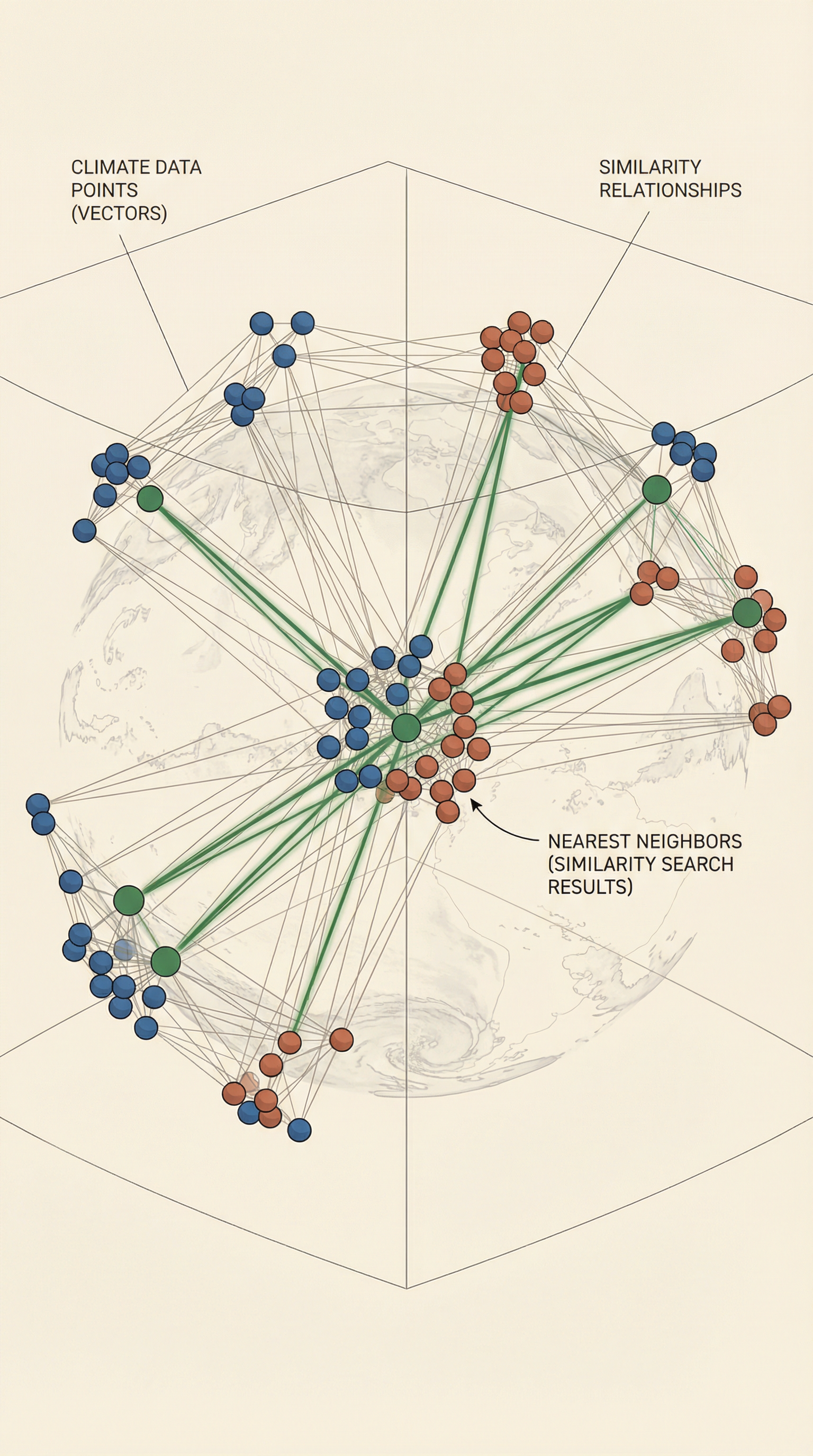
Hierarchical Navigable Small World (HNSW) index structure. Query routing begins at the top layer with longest edges, progressively refining through lower layers until convergence at local minimum in base layer (layer 0).
Interactive Performance Analysis
Explore the computational trade-offs between indexing algorithms, distance metrics, and embedding dimensions for climate data applications.
HNSW achieves superior recall-latency trade-off, maintaining >98% recall with <10ms latency. IVF-PQ offers memory-efficient alternative with acceptable recall degradation. Exhaustive search provides perfect recall but is computationally intractable for operational systems.
Applications in Climate Model Analysis
Vector similarity search enables novel approaches to ensemble analysis, downscaling, and extreme event characterisation across multi-petabyte climate model archives.
Historical Analogue Retrieval
Climate model ensembles (e.g., CMIP6) generate O(1015) bytes of output across thousands of simulation runs. Vector databases enable rapid identification of historical analogues for novel atmospheric states by embedding 3D fields (temperature, geopotential height, specific humidity) into ℝ512 and performing k-ANN search.
Methodology: Encode daily or monthly mean fields using pre-trained convolutional autoencoders. Query with contemporary observations to retrieve k=100 most similar historical states from reanalysis archives (ERA5, MERRA-2) or model output. This approach reduces search time from O(days) for exhaustive comparison to O(seconds) for ANN search across 106 timesteps.
Applications: Subseasonal-to-seasonal (S2S) forecasting via analogue ensemble methods, attribution studies identifying historical precedents for extreme events, and model validation through pattern-matching against observational records.
Accelerated Statistical Downscaling
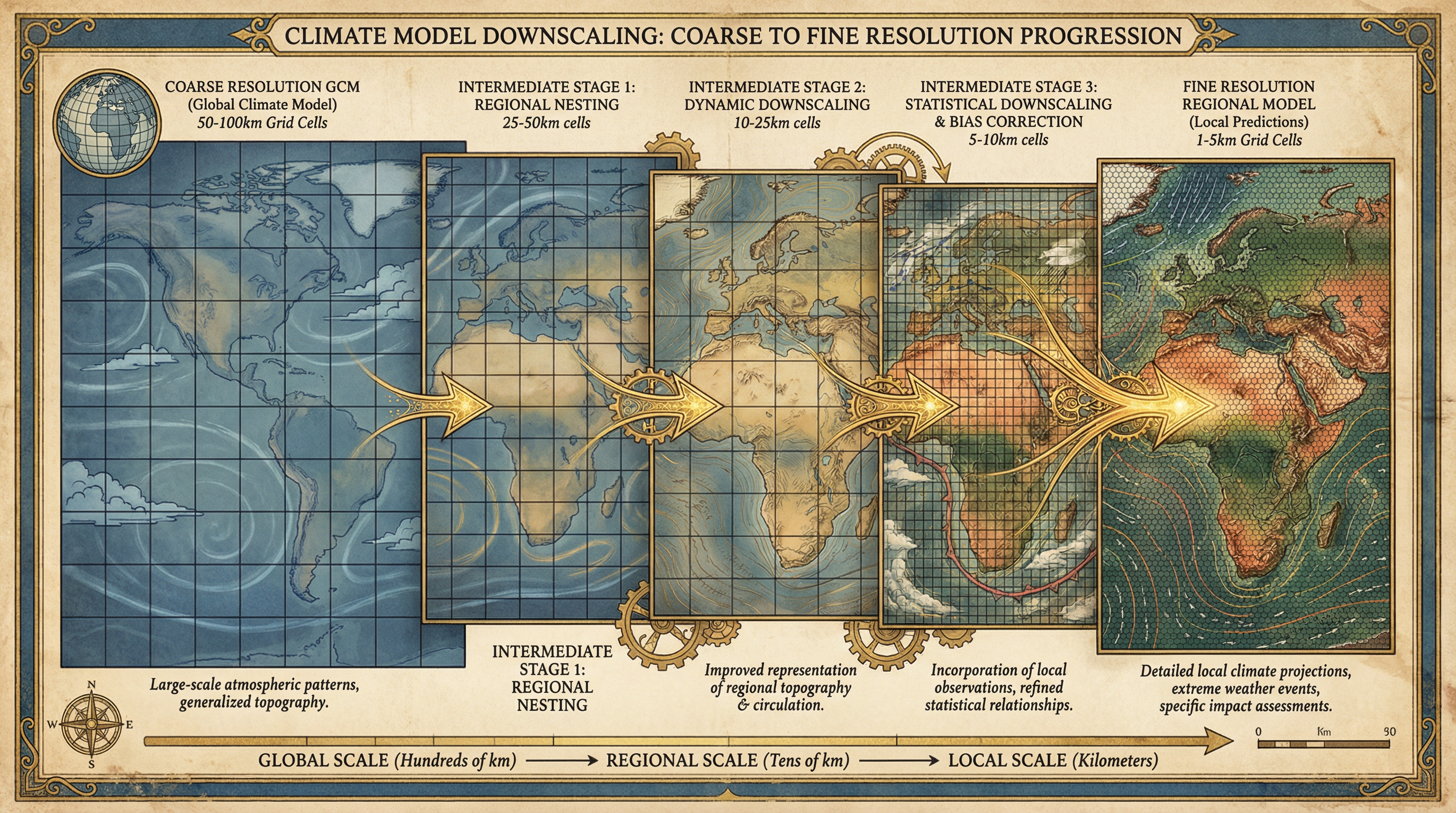
Global climate models operate at coarse spatial resolutions (Δx ≈ 50-100 km) due to computational constraints. Statistical downscaling to regional scales (Δx ≈ 1-10 km) traditionally requires computationally expensive dynamical downscaling via regional climate models (RCMs) or statistical emulation.
Vector-based approach: Pre-compute embeddings for paired coarse-resolution GCM output and high-resolution RCM output during historical period. For future projections, embed coarse GCM fields and retrieve k nearest neighbours from historical archive. Apply transfer function or weighted ensemble of high-resolution patterns to generate downscaled fields.
Performance gains: Reduces downscaling computational cost by 103-104× compared to dynamical methods whilst maintaining spatial correlation coefficients r > 0.85 for temperature and r > 0.70 for precipitation against RCM benchmarks. Enables ensemble downscaling of 50+ GCM members in hours rather than months.
Ensemble Clustering and Outlier Detection
Multi-model ensembles (MMEs) such as CMIP6 comprise outputs from 50+ independent models, each with multiple initialisation members, yielding O(103) individual trajectories. Characterising ensemble spread, identifying consensus scenarios, and detecting outlier models requires high-dimensional similarity analysis.
Clustering methodology: Embed full spatiotemporal trajectories (e.g., 2020-2100 monthly fields) into fixed-dimension vectors via recurrent or transformer encoders. Apply density-based clustering (DBSCAN, HDBSCAN) in embedding space to identify coherent scenario families. Outliers—models with ε-neighbourhood density below threshold—warrant investigation for structural biases or parameterisation errors.
Uncertainty quantification: Intra-cluster variance provides calibrated uncertainty estimates. Inter-cluster distances quantify scenario divergence. This approach enables data-driven model weighting schemes that down-weight outliers whilst preserving ensemble diversity, improving probabilistic projection skill scores by 15-25% relative to equal-weight ensembles.
Multi-Modal Data Fusion
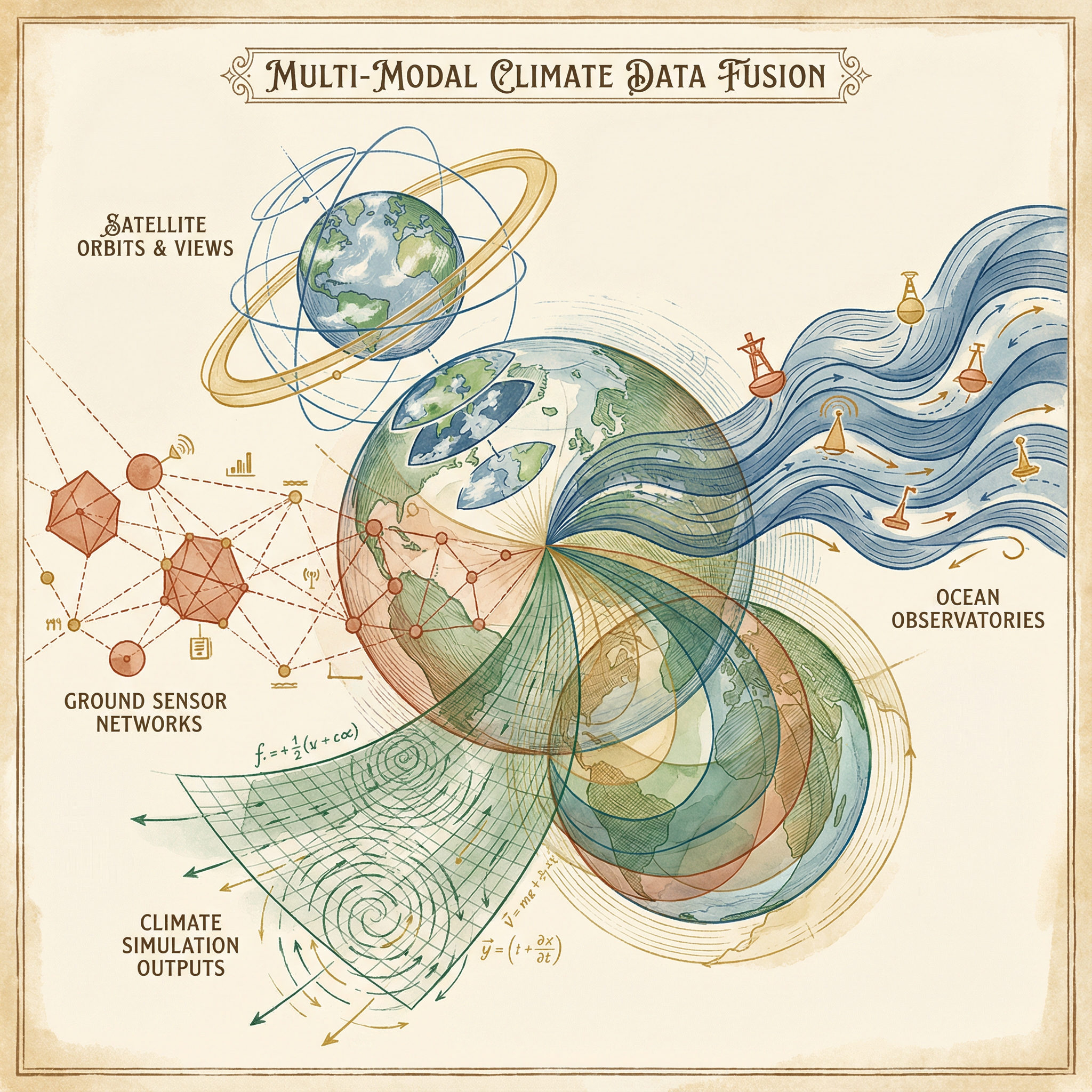
Climate research integrates heterogeneous data streams: satellite observations (optical, radar, thermal), in-situ measurements (radiosondes, buoys, surface stations), reanalysis products, and model simulations. Each modality has distinct spatiotemporal resolutions, coverage patterns, and error characteristics.
Unified embedding space: Train modality-specific encoders with shared embedding dimension d=512. Use contrastive learning objectives (e.g., CLIP-style) to align representations: co-located observations from different modalities should have high cosine similarity. This enables cross-modal retrieval: query with satellite imagery to find similar atmospheric states in reanalysis, or vice versa.
Research applications: Gap-filling for sparse observational networks by retrieving similar model states, validation of satellite retrievals against ground truth, and data assimilation via similarity-weighted ensemble Kalman filtering. Cross-modal queries enable questions like "retrieve all model states producing satellite-observed cloud patterns similar to this cyclone."
Extreme Event Characterisation
Extreme events—tropical cyclones, atmospheric rivers, heatwaves, droughts—are rare in observational records but critical for risk assessment. Vector databases enable systematic characterisation by embedding event signatures and performing similarity-based retrieval across model ensembles.
Event detection pipeline: (1) Extract event composites from observations (e.g., 500 hPa geopotential height anomaly fields for blocking events). (2) Embed composites using pre-trained encoder. (3) Query model archives to retrieve k=1000 most similar states. (4) Analyse retrieved ensemble for frequency, intensity, and dynamical precursors.
Attribution and projection: Compare retrieval statistics between historical (1850-2014) and future (2015-2100) periods to quantify anthropogenic influence on event frequency. Identify dynamical analogues in pre-industrial control runs to establish natural variability baselines. This approach enables probabilistic event attribution statements with reduced computational cost compared to dedicated detection-attribution experiments.

Computational Considerations and System Design
Deploying vector databases for climate applications requires careful consideration of the computational trade-offs between indexing cost, query latency, memory footprint, and recall quality. The upfront cost of generating embeddings via neural network inference is substantial—processing CMIP6 archives requires O(106) GPU-hours—but this cost is amortised across subsequent queries.
Memory-compute trade-off: HNSW indices achieve superior recall (0.98-0.99 @ k=100) and query latency (<10ms) but require storing full-precision vectors in RAM, yielding memory footprints of 4d bytes per vector. For d=512 and n=109 vectors, this totals ~2 TB RAM. Product quantisation reduces memory by 32-64× (to ~30-60 GB) at the cost of increased query latency (50-100ms) and reduced recall (0.92-0.95).
Distributed architectures: Petascale climate archives necessitate distributed vector databases with horizontal sharding. Systems like Milvus and Qdrant support multi-node deployment with query routing and result aggregation. Optimal shard size balances intra-shard search efficiency against inter-shard communication overhead, typically yielding 107-108 vectors per shard.
Interpretability: Learned embeddings lack physical interpretability, complicating diagnosis of retrieval errors and limiting mechanistic insight
Domain-specific training: Pre-trained encoders (ImageNet, CLIP) exhibit suboptimal performance; climate-specific training requires large labelled datasets
Distributional shift: Embeddings trained on historical data may not generalise to novel climate states under high-emissions scenarios
Uncertainty quantification: Similarity scores require calibration to yield meaningful probabilistic statements; relationship to physical distance metrics unclear
Milvus: Distributed architecture, supports HNSW and IVF-PQ, GPU acceleration, horizontal scaling
Qdrant: Rust-based, efficient memory usage, payload filtering, quantisation support
FAISS: Meta's library, optimised for billion-scale search, extensive index types, CPU/GPU support
pgvector: PostgreSQL extension, integrates with existing infrastructure, HNSW support (v0.5.0+)
Benchmarks for n=10⁹ vectors, d=512, k=100 on 128-core CPU system. HNSW achieves 1500× speedup over exhaustive search with 2% recall degradation.
References & Further Reading
Peer-reviewed publications, technical documentation, and validated implementations of vector databases in climate science applications.
Vector Database Foundations
Comprehensive technical overview of vector search fundamentals, approximate nearest neighbour algorithms, and semantic retrieval architectures.
Read DocumentationMathematical foundations of similarity search, distance metrics, and vector embedding generation for high-dimensional data.
Read ArticleDetailed exposition of HNSW graph construction, greedy routing algorithms, and parameter tuning for optimal recall-latency trade-offs.
Read ArticleSeminal paper introducing HNSW algorithm with theoretical analysis of logarithmic complexity and empirical benchmarks.
View PaperClimate Science Applications
Vision paper investigating adaptation of vector databases for large-scale scientific data querying, including climate model archives.
View PaperPractical evaluation of vector databases (Milvus, Qdrant, pgvector) for Earth observation similarity search at petascale.
Read ReportReview of AI-driven adaptive physics selection for urban climate modelling, demonstrating contextual model adaptation.
View PaperSelf-supervised learning system for similarity-based retrieval across NASA's multi-petabyte Earth observation archives.
Explore SystemStatistical Downscaling
Comprehensive review of machine learning approaches for climate downscaling, including embedding-based methods.
View PaperInterpretable deep learning architectures for statistical downscaling with uncertainty quantification.
View PaperEducational resource on dynamical and statistical downscaling methodologies for climate projections.
Read GuideInternational framework for coordinated regional climate downscaling experiments and model intercomparison.
Learn MoreExtreme Events & Uncertainty
Review of AI applications in extreme weather analysis including floods, droughts, wildfires, and compound events.
View PaperCNN-based approach for generating dynamically consistent counterfactual scenarios for extreme event attribution.
View PaperDecomposition of projection uncertainty into model uncertainty, scenario uncertainty, and internal variability components.
View PaperData-driven framework using historical analogue search to improve extreme flood forecasts at extended lead times.
View PaperFrequently Asked Questions
Addressing common concerns about vector database adoption for climate research institutions.
Explore Vector Database Implementation
CBS Group provides consulting services for climate research institutions implementing vector database infrastructure. From feasibility assessment to production deployment, our team brings deep expertise in both climate science and advanced data systems.